
He Stored Documents in His Bathroom. Now He’s Gutting the Records Law.

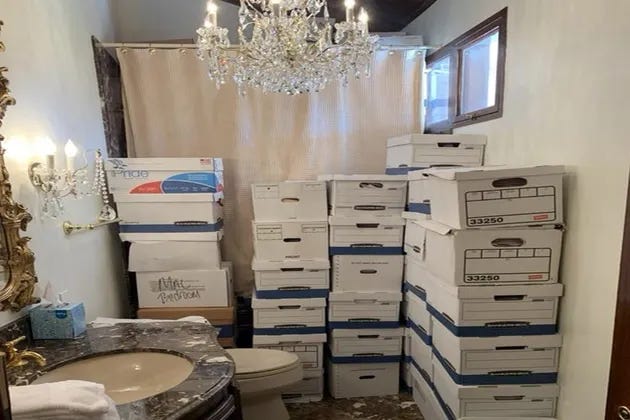
The big picture: The Trump administration has declared the Presidential Records Act unconstitutional, arguing Congress can’t compel the executive branch to preserve records. The law was passed after Watergate specifically to prevent a president from destroying incriminating materials. The president pushing to gut it has 34 felony convictions, a federal indictment for mishandling classified documents stored at Mar-a-Lago, and an administration that blocked the release of the special counsel’s final report.
Why it matters: Without the Presidential Records Act, no legal mechanism guarantees the public will ever see what happened inside this White House. Every future president would have the same power to decide what records survive. This isn’t a policy disagreement. It’s dismantling a post-Watergate safeguard that exists because we already learned what happens when presidents control the evidence.
What they’re doing: The DOJ declared the Presidential Records Act an overreach. A DOJ official: “Congress does not have the power to compel an entire branch of government to create and save every single possible piece of paper.” The administration says Congress could still access records through “negotiation.” The National Archives already releases records five years after a president’s term.
Why this law exists: Nixon wanted to destroy Watergate recordings. The law was passed in 1978 to ensure presidential records belong to the public, not the president. It’s been the standard for nearly five decades.
The suspicion: Trump has told White House staff to preserve documents for “historical value.” If they’re fine with eventual public access, why gut the legal requirement? During a time of war, scandals, and an administration of loyalty-first appointees, removing the one law that guarantees transparency isn’t a transparency move.
The track record: 37-count federal indictment for mishandling classified documents. Boxes stored in the Mar-a-Lago bathroom. Leaked audio of Trump acknowledging classified material: “As president, I could’ve declassified it, but now I can’t. This is still a secret.” The case was dropped when he was re-elected. A Trump-appointed judge blocked the special counsel’s final report. He’s been caught tearing up documents before.
The security risk: If he took classified documents home once, what stops him from doing it again without a legal preservation requirement? As threats from hacks and leaks grow, weakening the tracking system for presidential records isn’t just suspicious — it’s dangerous.
By the numbers:
34 — felony convictions
37 — counts in the original classified documents indictment
1978 — year the Presidential Records Act was passed
5 — years after a president’s term before records become publicly accessible
0 — mechanisms to guarantee public access without the law
The bottom line: The law exists because Nixon tried to destroy evidence. The president trying to kill it stored classified documents in his bathroom, was caught on tape acknowledging he had them, has 34 felony convictions, and blocked the public from seeing the special counsel’s findings. If this goes further, the question isn’t just what this administration is hiding. It’s whether any future president will ever be required to show what they did with the power they were given.
Thanks for reading! Comment your thoughts & reactions | Share to spread the word | Follow to stay in the loop